Sadly, Systemd has shown it's not committed to upholding the freedom of Linux, and I will not entertain them. Switching back to CachyOS where I can choose a different service manager. It's been a lovely ride with y'all.
If you want more info, you can find the pull request here:
Edit: Scratch that, Cachy is systemd too. Guess I'll have to get to work removing it myself or do some distro hopping.
And with MXLInux, you can install with Sysvinit, I think, opting out of systemd.
That said, the link you posted says they are reverting that change:
After extensive community discussion, legal review and consideration of
privacy implications, we have decided not to implement OS-level age
attestation / age bracket signaling as initially prototyped.
I heard that reversion was denied but I think you're right. Regardless, I'll keep an eye on it. Already made a patch that can theoretically remove it if it arrives lol.
That's a weird way to spell Microslop lol. Regardless, I'll spend all spare time I have removing everything related to this in whatever form it takes. Looks like it won't be added until v261, and the easiest approach would be probably be a live patch or system service rather than a fork, so we'll have to wait and see I guess.
It's an optional field in the userdb JSON object. It's not a policy engine, not an API for apps. We just define the field, so that it's standardized iff people want to store the date there, but it's entirely optional.
When You think about the Law Situation, the Linux World has to see how to handle that. and that is one Way to do it. And it is optional - yes, You can ask now ''How ong is it optional?''. A valid Point.
The whole Point is: How to handle this Age Verification Thing. When it is a Law, You can't simply say ''I don't go with it''. Or You do say that and consequently exclude all States and Countries who have that and will have that.
Disagreement with a law or a poorly written or implemented law is not grounds to ignore or break a law.
It makes sense that it cannot be this way - or the great many laws that are the foundation of systems, that prevent corruption, that protect people could be similarly ignored by simple 'disagreement.'
Laws can be amended or even overturned - or be ruled against in court.
Only 1 country and 1 state actually signed it in the law but enthusiasm with which Linux (including Zorin sounds like) jumps ahead of itself to implement it is very concerning and your justification that it cannot be ignored because its a law makes me thing again if Zorin should be running on my network.
Yes dude, you can ignore it unless half of the world implements it as a law. For now put disclaimer that not for use in Brasil and California and move on. What are you even talking about?
Found out on a YouTube video that MX-Linux has changed; it now provides separate .isos, ones with systemd and ones without - it is no longer a choice of init at point of install.
I decided to use Mojeek search engine to find out what the FSF (Free Software Foundation, setup by Richard Stallman) stance on Age verification is which came back with this:
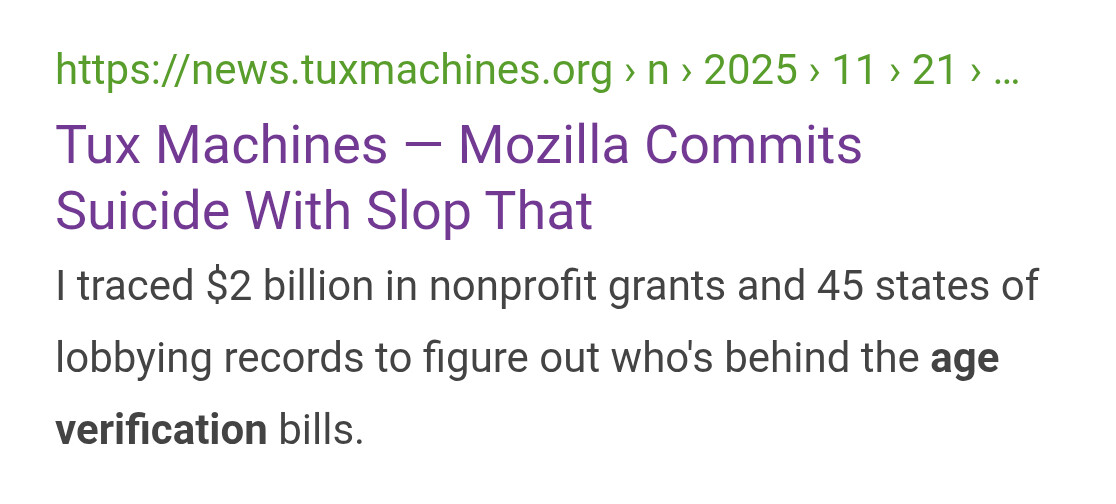
I could find no reference at all on tuxmachines site, so used the info in the body of text in Brave A.I. search which is the first result when choosing the Brave link at the bottom of Mojeek's first page of results and it gives this:
" Meta is the central entity behind a coordinated $2 billion lobbying campaign to push age verification laws across 45 U.S. states, according to a forensic investigation by researcher "upper-up" using public records.
Funding Mechanism : Meta funneled at least $70 million through fragmented super PACs and nonprofit shells (like the Digital Childhood Alliance) to evade Federal Election Commission (FEC) transparency rules.
Lobbying Strategy : The campaign used 59,736 donor-advised fund (DAF) recipients and $2 billion in dark money grants traced through the Arabella Advisors network, which operates multiple entities from a single Washington, DC, office.
Regulatory Capture : Proposed laws require OS-level age verification APIs from Apple and Google, creating permanent surveillance infrastructure, while Meta’s own platforms are exempt —a clear competitive advantage.
Privacy Impact : These bills mandate uploading government IDs and facial recognition data to commercial third-party vendors , creating honeypot databases. In contrast, the EU uses privacy-preserving zero-knowledge proofs —a technically feasible alternative not adopted in the U.S.
Consequences : The compliance burden—estimated at $100K to $2M per year —is unaffordable for small platforms, indie developers, and open-source projects, effectively killing pseudonymity and consolidating the internet on big platforms .
This is not about child safety—it’s about corporate control of the internet , using government to build surveillance infrastructure that benefits Meta while harming competitors and user privacy.
But this is what I already wrote: You can say No. But then You have to take the Consequence and don't offer the OS for the specific States/Countire's who have a Law like this.
And to be honest: I don't like some of the Wording. For example:
The Conformists: Canonical, Elementary, and Pop!_OS
This marks a clear philosophical split: corporate-friendly Linux versus freedom-first Linux.
Again: They can be against that. But they are not above the Law. And as long as this Law exists, Companies like Canonical or System76 have to respect it - or they take the Consequence and do no Business in Regions like this. That hasn't to do anything with Conformism.
And it isn't philosophical, too. That is only meaningless Wording. there is a Law and You have to see how You will handle with it - Zorin have to do that, too. And we will see what the Zorin Dev's do. When Canonical makes something and implement it or do they take the systemd Option, we will see what Zorin takes. Or if Zorin goes the same Way like others and doesn't offer the OS in the Regions with these Laws.
Electronic Frontier Foundation, the organisation fighting for our computer freedoms. It's in my earlier post.
Having said all this essentials like food take precedence over tech. I've already seen headlines forecasting the world economy will hit a brick wall in less than 2 months. Perhaps the 2030 reset is too far away for some, when "You will own nothing, and be happy" (WEF).